Latest

  • The estimated reading time for this article is about 4 minutes.

    There is a lot of unhinged fearmongering around the growing power of LLMs and agentic harnesses. Much of this prattle is from the very people making the product:

    "The vast power of superintelligence could also be very dangerous, and could lead to the disempowerment of humanity or even human extinction." – OpenAI

    or

    "[The] Intellect we don't fully understand" – Jakub Pachocki

    Are you good and scared yet? That is the point of those posts.

    At the heart of AI is a very clever, but ordinary bit of software called a Large Language Model. This model has only one job: to predict new words that are likely to follow the words it got as input. Are you trembling in terror yet?

    So, there is little need to fear powerful large language models. They can only emit text. They cannot read a file, look at a web site, control your mind, or drain your bank account.

    The issue is the software that connects the output of the idiot word predictor and attaches that to a set of programs. That is the essence of what are termed "agentic workflows." An agentic workflow is the metaphorical arms and legs of the giant robot lumbering towards you.

    Let me cut to my point: Agentic workflows need proper sandboxes.

    "Agentic workflows" are actually not a new threat. Information technology has long dealt with programs that use system tools to execute a workflow that the user did not intend. We call that kind of program a "virus", or "worm", or "malware".

    So, indulge me for a moment while I cast "agentic workflows" into the most unkind light possible of malicious software. Here, I mean that we don't know what an agentic workflow will actually attempt to do before we run it. It could indeed hijack its host system to do all manner of naughty things.

    If you knowingly installed malicious software on your PC that was connected to your corporate LAN, you will, at a minimum, be getting an unpleasant visit from Network Security.

    But security experts really do have to install and often execute malicious software to understand how it works and how it can be defeated. They do not put this software on a normal machine. They add multiple layers of network isolation so that is not possible for software to touch systems outside of a testing regime.

    That's called being a responsible computer operator. LLMs are operating under your personal authority.

    Where are the calls for users of agentic workflows to demonstrate the same level of professionalism and foresight that has long been the practice of computer professionals in other contexts?

    LLMs can generate code faster than humans. But worms have done that for years. An LLM could build a compiler on a machine that simply allows it to write to a file system. From there, creating arbitrary executables is only a matter of time.

    We trust (mostly) JavaScript to run in our browsers without compromising our machines. Sandboxing is proven technology. Perhaps AI bros can stop pushing us to run their software without limits? Of course, that will cut into subscription fees.

    We also need meaningful liability laws around LLM use. If I hack a corporate website, I am going to face legal penalties. If an LLM does this, even without my permission, I should be held liable.

    And, lest accusations of Luddism be thrust upon me, I have a local LLM rig in my basement with which I am quite pleased.

    Do not trust the technology to be responsible. Hold humans accountable for their actions. The law already works like this in most situations. AI should be no different.
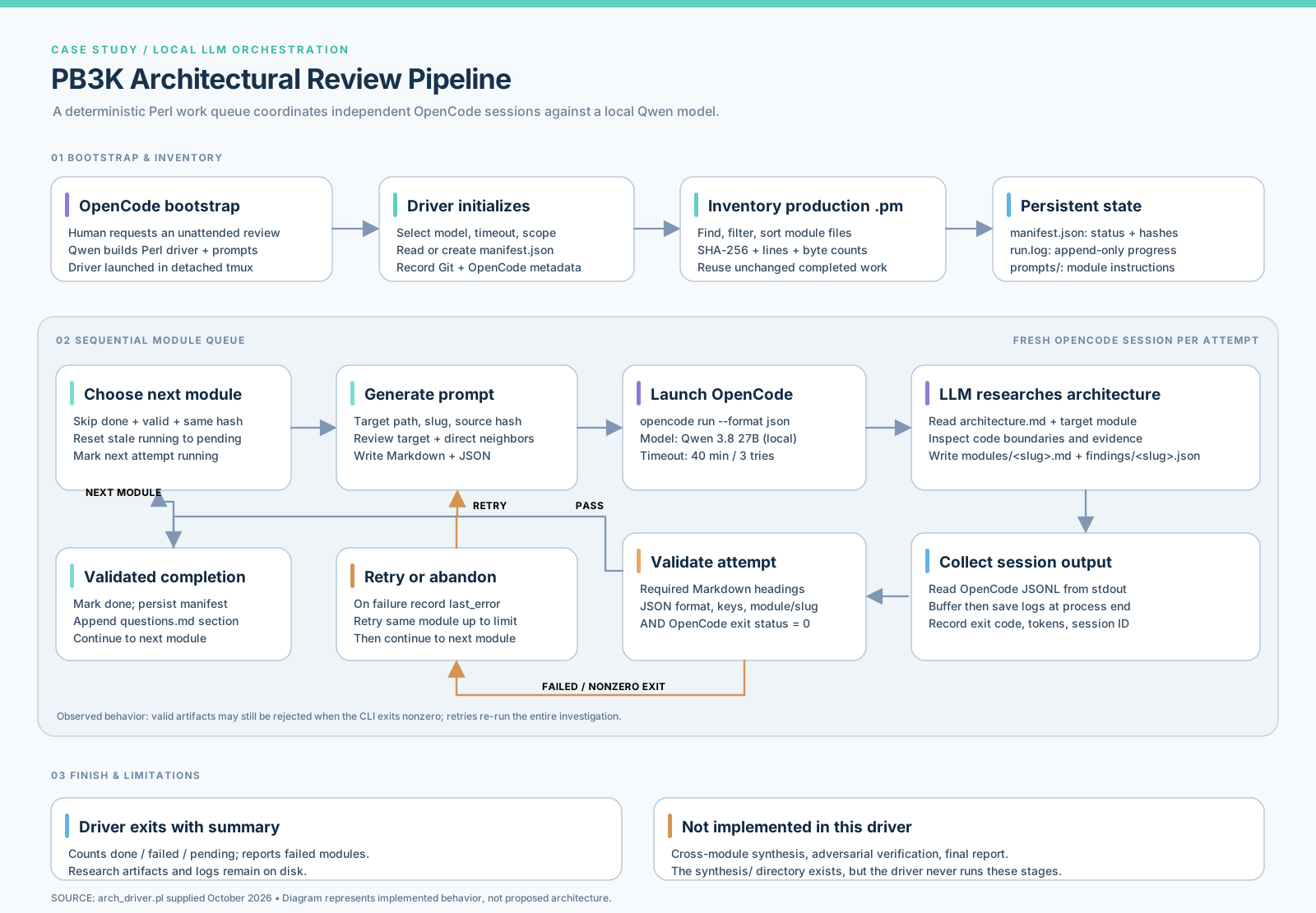
  • The estimated reading time for this article is about 3 minutes.

    PB3K architectural review pipeline

    Whelp, that certainly is a flowchart. Let's stick a pin in that for a bit.

    I have a modest unified memory archive AMD Strix Halo machine with 64GB of RAM running Ubuntu with ROCm. I bought this in early September 2026 and with Amazon points, it was still too much money. Certainly, the most I have ever spent on non-Apply hardware.

    I use opencode (and have a basic Go subscription) and ChatGPT (with a Plus subscription). My goal is to minimize my use of frontier LLMs for private projects. I think now have such a rig.

    I run three models on this host (called Colossus):

    • Qwen3.8-27B-UD-Q4_K_XL (a dense model with a 64K context)
    • Qwen3-Coder-30B-A3B-Instruct-Q4_K_M (a Mixture of Experts model with 128K context)
    • gpt-oss-20b-F16 (MoE model with 128K context)

    Using the frontier model, benchmarking scripts were created to dial in the settings on these LLMs.

    Only one LLM runs at a time, but I have a script that launches llama server with a router. I run that one script and then I can select the model I want to use in OpenCode.

    The MoE models (once they are loaded) run very well and have snappy token generation. However, their reasoning is questionable. Their tool use is OK.

    The Qwen 3.8 model is slow (about 10 t/s) but accurate. This is my go-to model when I need the LLM to do software engineering and discovery tasks correctly.

    Which brings me to this monster flow chart.

    I have a game called ProspectBoy 3000. And although a lot of the game works as expected, the architecture went a little pair-shaped in places. I have fixed some of this by hand, but know I constructed an architectural review with Qwen.

    This workflow is particularly challenging because there is only one agent in the loop at a time. Therefore, a perl driver is used to launch opencode with instructions that examine only one Perl library file at time. The results are written to disk. The list of modules to examine is also updated.

    This review has been going for 16 hours without my intervention. I will likely go for another 48 hours.

    Qwen is fantastic. I can work around latency. I can't work around inaccuracy.

    When I need interactivity, I have the MoE models which are great too.

    Given the insane prices of VRAM, I have to believe 2027 will be the year of local LLMs. The good news is, many workflows already are possible on 64GB machines. 128GB is a luxury as is speed. If you can get it though, take it.

    Cheers,

  • til chatgpt can read atari2600 roms

    ChatGPT can read atari2600 ROMs. I uploaded Adventure, told it that I think there is bug
    in 3rd variant of the game where items get put into inaccessible places, and the LLM
    confirmed the bug!

    This variant distributes items by using the table the statically placed items in
    various location in variant 2. It takes that table and simply shuffles the locations
    assigned to those items. So one set of locations have a fixed place where item will
    occur. It's just that items get distributed differently to those location when you
    reset a variant three game. Super-slick hack!

    There is no validation logic, however, that prevents the gold key from starting
    in the gold castle. Wump, wump. Start again.

    Anyway, I don't think Warren Robinett is accepting patches.
  • The estimated reading time for this article is about 4 minutes.

    Deep Learning (DL) is a slightly out of date term for training neural networks on digital content in order to recognize patterns. This technique led to driver-assisted cars, medical insights, self-focusing cameras, and a host of other technologies and produce affordances we have all come to depend upon.

    I do not hear a lot of complaints on the Internet that self-focusing cameras are running photography.

    The marketing term "generative Artificial Intelligence" stuck in my increasing graying maw from day one. Large Language Models (LLM) are still primarily DL engines. Sure, there is some "reasoning" sprinkled on top. That word "reasoning" should be looked at like a legal term, rather than understand as a plain English term.

    The best way to look at the output of LLMs is a bit like the old Plinko game. You put a disk (or a your word salad) on the top and that bounces around randomly until you get something out at the bottom of the board. The AI tech companies are trying to make the shape of that Plinko board "useful," to which I say "good luck."

    LLMs are another in a long lime of tech tools that over-promise capability and under-promise value. The only ones who think "the game has changed" are those same managers who have been looking to fire employees for my entire career. AI has only made their fever dreams more sweaty.

    Lest you think I am a Luddite advocating for the pitchforks and bonfires, please understand that I use AI tools every day gladly. However, just like with a chainsaw, I do not let the AI tools think for me. I have to drive, cajole, plead, and sometimes override the code tools like Claude Code and OpenCode produce. That is my value as an engineer and it has been for decades. I am responsible for the architecture of an application. Sometimes (often) that architecture is not just the sweeping design document, but the crafting to the way smaller parts handle just enough work to be useful, but not so much that they become monolithic, over-balanced clown shows.

    AI does not do this last part well. It cannot.

    By now, I trust we can all recognize all but the best LLM generated voice messages. We can easily spot AI crafted text. This combo is the bane of YouTube right now. However, I will admit that AI-generated graphic appeal to me as a non-graphic artist. If the image has no factual mistakes, I am hard-pressed to tell the difference. That is certainly not art, but neither are stock photos and clip art.

    The danger of AI is that people can become intellectually lazy. Rather than have an LLM suggest copy edits for text, user copy the AI output blindly. But we have been here before. Twenty five years ago, shame and opprobrium where heaped on those who "googled" for answers. Thirty years ago, movies and TV that used computer generated graphics were similar denigrated.

    Creative and curious people will continue to do great things using the tools that are available to them at the time, including LLMs. Lazy people will continue to be lazy, just at a faster pace. As I said, this has all happened before and should not overly concern you.

    As for AI-slop, that is a curious category of output. I suspect as we demand higher-quality content, AI-slop will become unprofitable. But low-quality content has always been with us. Media with factual errors is the foundation of my childhood.

    To quote Battlestar Galactica one more time: this has all happened before.

    This essay is in response to my friend Nate's very understandable complaints about lazy people using AI to be unhelpfully lazier.